
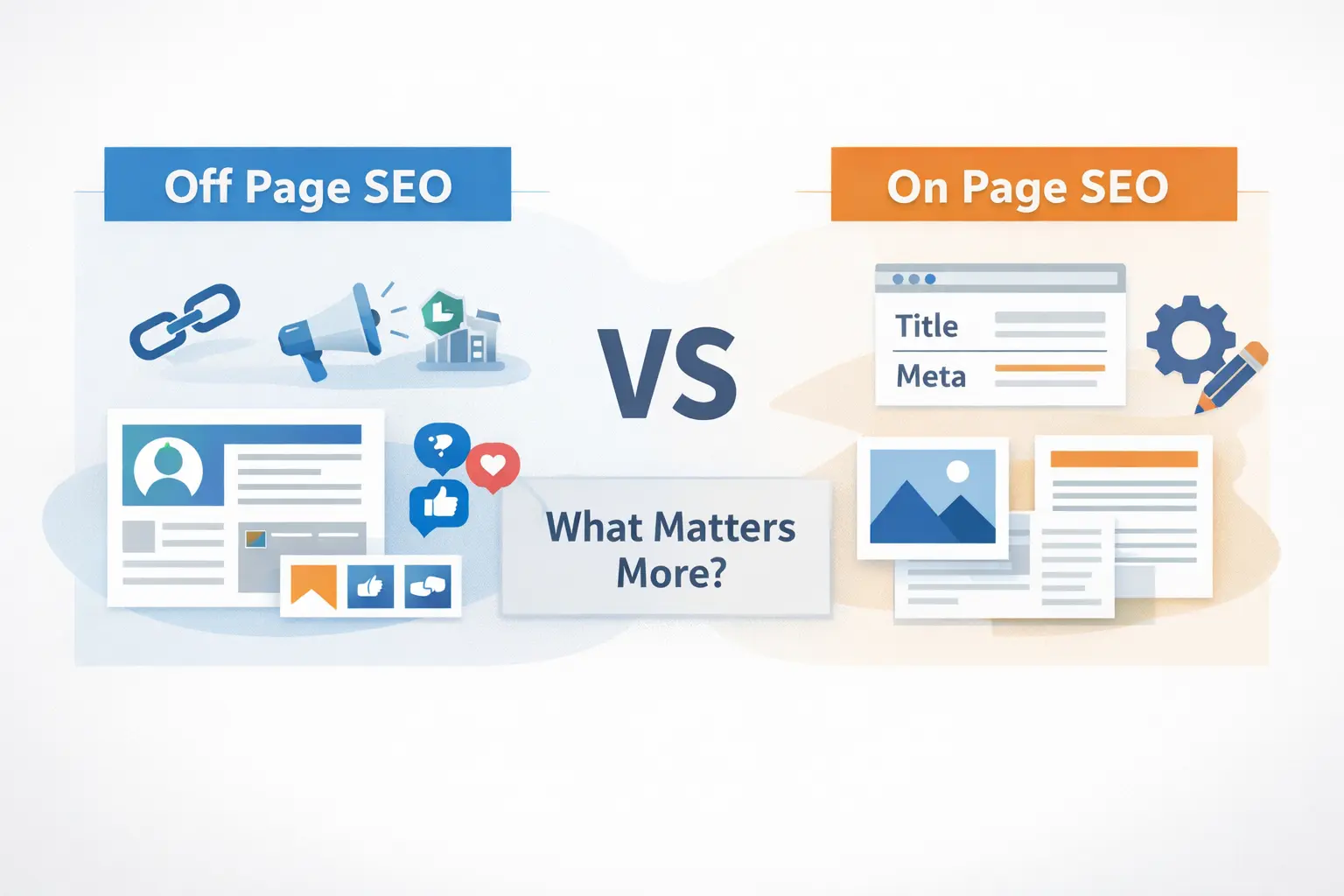
Search engine optimization is no longer just about adding keywords to a page. In today’s competitive digital landscape, authority, trust, and brand signals play a bigger role than ever. This is why the debate around Off Page SEO Checklist vs On Page SEO continues to dominate SEO discussions.
Many websites follow every on-page best practice yet fail to rank. Meanwhile, others with average content sit comfortably on page one. The difference almost always comes down to how well the off page SEO checklist is executed.
In this detailed guide, you’ll learn:
What On Page SEO and Off Page SEO really mean today
A complete, updated off page SEO checklist with real-world validation
Which matters more for rankings (with proof from Google & industry leaders)
How to balance both for long-term SEO growth
Understanding On Page SEO in Detail
On Page SEO refers to optimizations you make within your website so search engines can understand your content and users can engage with it.
Core On Page SEO Elements
Keyword Optimization
Title tag
Meta description
H1, H2, H3 structure
URL optimization
Content Quality
Original, helpful, and in-depth content
Search intent matching
Proper content formatting
Technical On Page Factors
Page speed
Mobile friendliness
Core Web Vitals
HTTPS security
Internal Linking
Contextual internal links
Logical site architecture
Crawl efficiency
According to Google, on-page signals help search engines understand content, but they do not guarantee rankings without authority.
What Is Off Page SEO? (And Why Google Trusts It More)
Off Page SEO includes all ranking signals that happen outside your website. These signals show Google that other people trust, reference, and recommend your site.
This is exactly why the off page seo checklist carries more ranking weight for competitive keywords.
Core Off Page SEO Signals
Backlinks
Brand mentions
Social visibility
Reviews & reputation
Digital PR
Local citations
A well-known study by Ahrefs confirmed that over 90% of pages ranking on Google have at least one backlink, while pages with no backlinks rarely rank.
Why the Off Page SEO Checklist Is Critical After Google Updates
Google’s algorithm updates (Helpful Content, SpamBrain, Link Spam) focus heavily on E-E-A-T.
Off page signals support:
Experience – real usage & mentions
Expertise – citations from niche authorities
Authoritativeness – backlinks from trusted domains
Trustworthiness – reviews, brand presence, PR
This is why modern SEO success depends on a structured off page SEO checklist, not random link building.
Complete Off Page SEO Checklist (With Proof & Best Practices)
Below is a fully actionable off page SEO checklist, validated by industry leaders.
1. High-Quality Backlink Building (Most Important Factor)
Backlinks remain Google’s strongest ranking signal.
🔗 Google’s own documentation confirms that links are one of the top three ranking factors (Source: Google Search Central).
Off Page SEO Checklist for Backlinks
Focus on relevance over quantity
Earn contextual links inside content
Maintain natural anchor text ratios
Avoid link schemes or paid spam links
According to Backlinko, pages with more referring domains rank significantly higher than those with fewer links.
2. Guest Posting (White-Hat & Scalable)
Guest blogging still works - when done correctly.
Checklist
Publish on real websites with organic traffic
One branded or partial-match anchor
Content must add value
Avoid PBN-style guest networks
Search Engine Journal confirms guest posting remains safe when links are editorial and not manipulative (SEJ, Link Building Guidelines).
3. Brand Mentions (Linked & Unlinked)
Google recognizes brand mentions even without links.
Checklist
Monitor brand mentions using alerts
Convert unlinked mentions into backlinks
Increase branded searches
Build thought leadership content
Moz states that brand authority strongly correlates with ranking stability.
4. Digital PR & Editorial Links
Digital PR earns high-authority backlinks naturally.
Checklist
Create data-driven content
Pitch journalists and bloggers
Use HARO / PR platforms
Secure editorial links (not paid)
According to Search Engine Journal, editorial links are the hardest to get and the most valuable.
5. Social Signals & Content Amplification
Social media doesn’t directly rank pages, but it amplifies off page SEO.
Checklist
Share content consistently
Drive referral traffic
Increase content discovery
Improve brand recall
Google’s John Mueller has stated that social signals indirectly support SEO by increasing visibility and link potential.
6. Local SEO & Citations
Essential for location-based businesses.
Checklist
Google Business Profile optimization
NAP consistency
Industry directories
Local backlinks
BrightLocal reports that citations directly impact local pack rankings.
7. Reviews & Online Reputation
Trust drives clicks and rankings.
Checklist
Encourage genuine customer reviews
Respond professionally
Build trust across platforms
Avoid fake reviews
According to Trustpilot, positive reviews increase conversion rates and brand trust signals.
8. Forums, Communities & Q&A Platforms
When done right, this builds authority + referral traffic.
Checklist
Add value-first responses
No spammy links
Build expert profiles
Drive topical relevance
9. Influencer & Expert Collaborations
SEO is relationship-driven.
Checklist
Co-create content
Podcasts & interviews
Expert roundups
Cross-promotions
Authority endorsements accelerate trust faster than solo efforts.
10. Toxic Link Monitoring & Disavow
Bad links can hurt rankings.
Checklist
Monthly backlink audits
Identify spam domains
Disavow only when necessary
Maintain healthy link velocity
Google’s SpamBrain actively neutralizes manipulative backlinks.
On Page SEO Checklist (Foundation Layer)
Before executing the off page SEO checklist, your site must be optimized.
Essential On Page Checklist
One primary keyword per page
Search intent–matched content
Proper heading hierarchy
Internal linking
Fast page speed
Mobile-first design
Optimized images
Clear CTA
Off Page SEO Checklist vs On Page SEO (Side-by-Side)
Factor | On Page SEO | Off Page SEO |
|---|---|---|
Control | Full | Partial |
Trust building | Low | High |
Ranking impact | Medium | Very High |
Time to results | Faster | Slower but lasting |
Competitive SEO | Limited | Essential |
What Matters More for Rankings?
Honest SEO Truth
On Page SEO helps you qualify
Off Page SEO helps you win
For low competition keywords, on-page SEO may be enough.
For medium to high competition keywords, off page SEO checklist execution decides rankings.
Ahrefs confirms that higher-ranking pages consistently have stronger backlink profiles.
Real Ranking Example
Website A
Perfect on-page SEO
No backlinks
No brand mentions
Website B
Good content
Strong backlinks
Active brand presence
Website B outranks Website A in almost all cases.
Ideal SEO Strategy (2026-Proof)
40% On Page SEO
60% Off Page SEO
Start with technical and content optimization, then scale your off page SEO checklist aggressively but safely.
Common Off Page SEO Mistakes to Avoid
Buying cheap backlinks
Exact-match anchor spam
Ignoring brand building
No backlink audits
Chasing DR instead of relevance
Tools to Execute Your Off Page SEO Checklist
Google Search Console
Ahrefs / SEMrush
Moz Link Explorer
Google Alerts
HARO
Screaming Frog
Final Verdict
On Page SEO builds relevance.
Off Page SEO builds authority.
But Google ranks authority first.
If you want consistent page-1 rankings, your off page seo checklist must outperform your competitors, not just match them.
Conclusion
SEO success is not about choosing between On Page or Off Page SEO. It’s about mastering both with a stronger focus on off page authority.
If you want real growth:
Optimize your pages
Build trust externally
Follow a structured off page SEO checklist
Stay consistent