
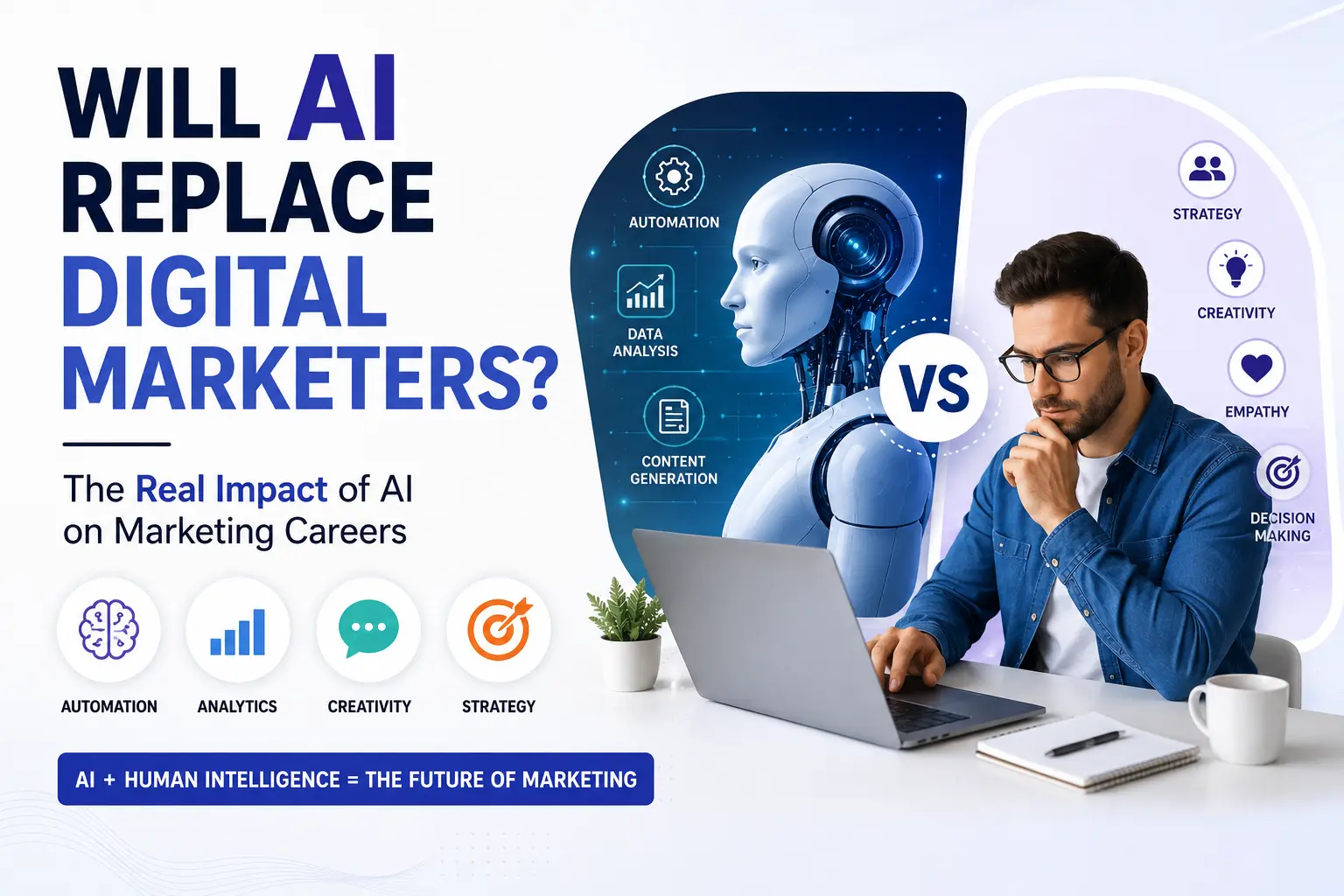
Artificial Intelligence has moved from being a futuristic concept to an everyday business tool. From generating content and analyzing customer data to creating ad variations and automating repetitive tasks, AI is changing how marketing teams work.
This rapid transformation has created an important question for students, freshers, working professionals, and experienced marketers:
Will AI replace digital marketers?
The short answer is not entirely - but AI will change the role of digital marketers significantly.
Some repetitive marketing tasks are already becoming automated, while new responsibilities are emerging around AI strategy, data interpretation, creative direction, customer experience, and human oversight. Recent marketing research shows that AI is increasingly being used as an assistive technology rather than a complete replacement for marketing professionals. HubSpot's 2025 research found that 91% of marketing leaders said employees or teams in their organizations use AI to assist with their work.
This means the real question is no longer simply whether AI will replace digital marketers. The more useful question is:
Will digital marketers who know how to use AI replace those who don't?
Let's explore what AI is changing, which marketing tasks are most vulnerable to automation, what skills will remain valuable, and how aspiring marketers can prepare for the future.
What Does AI Mean for Digital Marketing?
AI in digital marketing refers to using artificial intelligence and machine learning technologies to improve marketing research, content creation, advertising, analytics, personalization, automation, and decision-making.
Modern marketers can use AI to:
Generate content ideas
Research keywords
Create ad copy variations
Analyze large datasets
Identify customer patterns
Personalize marketing messages
Automate email campaigns
Generate images and videos
Summarize reports
Assist with SEO research
Improve campaign optimization
Automate repetitive administrative tasks
AI can complete many tasks faster than a human. However, speed does not automatically equal good marketing.
Marketing still requires understanding people, businesses, emotions, competition, positioning, brand identity, and customer intent.
That is where human expertise remains important.
Will AI Replace Digital Marketers?
AI is unlikely to completely replace digital marketers in the near future. Instead, it is more likely to automate specific tasks within marketing roles and change the skills employers expect from professionals.
Think about a digital marketing executive who previously spent several hours creating multiple ad-copy variations.
With AI, the marketer can generate dozens of variations quickly.
But someone still needs to decide:
Which message fits the brand?
Which audience should receive it?
Is the claim accurate?
Does the creative reflect the company's positioning?
Which campaign objective should be prioritized?
Are the results actually meaningful?
What should be changed based on customer behavior?
AI can assist with execution, but marketing strategy requires context and judgment.
This distinction is becoming increasingly important as AI adoption grows. HubSpot's research found that 65% of marketers surveyed viewed AI as an assistive tool while cautioning against becoming overly dependent on it.
Which Digital Marketing Tasks Can AI Automate?
Not every marketing activity is equally exposed to automation.
Tasks that are repetitive, structured, and data-heavy are generally easier for AI systems to assist with.
1. Content Ideation
AI can quickly generate:
Blog topics
Content calendars
Headlines
Video concepts
Email subject lines
This can save marketers considerable time during the planning stage.
However, marketers still need to evaluate whether an idea is relevant to the audience and business.
2. Basic Content Drafting
AI can create initial drafts for:
Blog posts
Product descriptions
Social media captions
Email newsletters
Ad copy
Video scripts
But publishing AI-generated content without proper review can create quality, factual, brand, and originality problems.
Current marketing research shows that most marketers still edit AI-generated outputs rather than publishing them unchanged. HubSpot reported that only a small minority of marketers using AI rely on completely unedited AI-generated content.
The future is therefore more likely to involve AI-assisted content creation than completely human-free content production.
3. Data Analysis and Reporting
Marketing teams often spend significant time preparing reports and identifying patterns in campaign data.
AI can help marketers:
Summarize performance
Identify unusual changes
Compare campaign results
Organize data
Generate preliminary insights
Detect trends
This allows marketers to spend less time preparing spreadsheets and more time deciding what actions should follow.
4. Advertising Optimization
AI can assist with:
Audience analysis
Bid optimization
Ad variations
Budget allocation
Predictive insights
Campaign recommendations
Advertising platforms themselves are increasingly incorporating automation and machine learning.
However, marketers still need to define business goals, understand customer economics, evaluate creative performance, and decide how campaigns fit into the broader marketing strategy.
5. Marketing Automation
AI can automate repetitive workflows such as:
Email sequences
Lead nurturing
Customer segmentation
Follow-up messages
Scheduling
Reporting
This doesn't necessarily eliminate marketing jobs. Instead, it can allow professionals to spend more time on strategy and customer experience.
HubSpot's research found that 78% of marketers surveyed agreed AI helps reduce time spent on manual tasks.
What AI Cannot Easily Replace
The biggest misconception about AI is assuming that marketing is simply a collection of tasks.
It isn't.
Successful marketing involves understanding why people behave the way they do and creating a strategy around that understanding.
Several human capabilities remain particularly valuable.
Strategic Thinking
A company may have thousands of possible marketing opportunities, but someone must decide which ones matter.
A marketer needs to understand:
Business objectives
Customer segments
Competition
Market positioning
Budget limitations
Growth opportunities
AI can provide recommendations, but business decisions require context.
Creativity
AI can generate hundreds of ideas, but quantity doesn't guarantee originality.
Human marketers are still needed to develop:
Brand personality
Campaign concepts
Emotional storytelling
Creative direction
Unique positioning
The strongest future marketing teams are likely to combine AI's speed with human creativity.
Customer Understanding
Customers aren't spreadsheets.
Their decisions are influenced by:
Emotions
Trust
Culture
Personal experiences
Social influence
Brand perception
Marketers need to understand these factors when developing campaigns.
Communication
Marketing professionals regularly communicate with:
Clients
Designers
Developers
Sales teams
Business owners
Customers
Strong communication and collaboration skills remain difficult to automate completely.
AI Will Change Digital Marketing Jobs
The biggest impact of AI may not be job elimination it may be job transformation.
Some traditional responsibilities may become less important, while new responsibilities emerge.
For example:
Traditional Task | AI-Assisted Future |
|---|---|
Manual keyword research | AI-assisted research + human strategy |
Writing basic ad copy | AI-generated variations + human editing |
Manual reporting | Automated reports + human interpretation |
Content brainstorming | AI ideation + human creative direction |
Data sorting | AI-assisted analysis + strategic decisions |
Repetitive email creation | Automated workflows + customer strategy |
Basic image creation | AI-generated concepts + creative supervision |
The marketer's role gradually moves from doing every task manually toward directing, evaluating, optimizing, and making strategic decisions.
Will AI Replace SEO Professionals?
SEO is another area where AI is creating uncertainty.
AI can help with:
Keyword clustering
Content outlines
Search intent analysis
Competitor research
Schema suggestions
Content optimization
Technical analysis
But SEO professionals still need to understand:
Search intent
Website architecture
Technical SEO
Internal linking
Content quality
User experience
Business objectives
Search ecosystem changes
SEO is not simply about putting keywords into content.
A strong SEO strategy requires understanding how a website, audience, business model, and search landscape interact.
Therefore, AI is more likely to become an SEO professional's productivity tool than a complete replacement for SEO expertise.
Will AI Replace Social Media Marketers?
Social media marketing is also changing rapidly.
AI can help create:
Captions
Post ideas
Content calendars
Visual concepts
Video scripts
Hashtag suggestions
Performance summaries
But successful social media marketing requires understanding:
Brand voice
Cultural trends
Audience emotions
Community conversations
Influencer relationships
Creative storytelling
A human social media strategist still needs to understand what the audience cares about and how the brand should participate in the conversation.
What Skills Will Digital Marketers Need in the AI Era?
If you're planning to build a career in digital marketing, the best strategy isn't to compete with AI.
Learn how to work with it.
Here are some of the most valuable skills for future marketers.
1. AI Literacy
You don't necessarily need to become an AI engineer.
You should understand:
How generative AI works
Prompt writing
AI-assisted research
AI content workflows
AI limitations
Fact-checking AI outputs
Responsible AI usage
2. Data Analytics
As automation increases, marketers who can interpret data become more valuable.
Learn:
GA4
Google Tag Manager
Conversion tracking
Campaign reporting
Customer behavior analysis
Basic data interpretation
3. Marketing Strategy
Learn to connect marketing activities with business objectives.
Understand:
Customer journeys
Buyer personas
Conversion funnels
Positioning
Lead generation
Customer acquisition
Retention
4. SEO and Search
Search is changing, but the ability to understand customer intent and online visibility remains important.
Develop knowledge of:
Local SEO
Content strategy
Search intent
Structured data
AI search and emerging search experiences
5. Paid Advertising
Learn how platforms such as Google Ads and Meta Ads work, but don't stop at campaign creation.
Understand:
Audience targeting
Conversion tracking
Creative testing
Budget allocation
Campaign objectives
Performance analysis
6. Communication and Critical Thinking
These skills become even more important in an AI-driven workplace.
A marketer needs to question AI outputs rather than blindly accept them.
Ask:
Is this accurate?
Is this useful?
Does this match the brand?
Will the customer care about it?
That human judgment is extremely valuable.
AI May Actually Create New Digital Marketing Careers
AI isn't only changing existing roles. It is also creating new opportunities.
Emerging roles may include:
AI Marketing Specialist
AI Content Strategist
Marketing Automation Specialist
AI Search Strategist
Prompt Specialist
AI Content Editor
AI Marketing Analyst
Marketing Data Specialist
AI Campaign Strategist
Current job listings already show demand for professionals who combine digital marketing knowledge with AI evaluation, prompt engineering, content quality assessment, analytics, and human judgment.
This suggests that the future of marketing may not be human versus AI.
It may be humans who know how to use AI versus humans who don't.
What Should Students Do to Stay Relevant?
Students entering digital marketing should avoid learning only individual tools.
Tools change quickly.
Instead, build a strong foundation in marketing principles and then learn how AI can improve those skills.
A future-ready learner should focus on:
SEO
Google Ads
Social Media Marketing
Content Marketing
Analytics
WordPress
Conversion Optimization
AI tools
Marketing automation
Prompt engineering
Practical live projects
Most importantly, work on real projects.
A portfolio showing what you actually achieved can be more valuable during an interview than a long list of certificates.
Is Digital Marketing Still a Good Career?
Yes but the profession is evolving.
The World Economic Forum's 2026 work on AI and entry-level employment highlights that AI-driven task changes are particularly important for early-career workers, making adaptability and skill development increasingly important.
For aspiring digital marketers, this means the safest approach isn't to avoid AI.
It is to become AI-ready.
A marketer who can combine:
Marketing Knowledge + AI Skills + Analytics + Creativity + Human Judgment
can offer considerably more value than someone who only knows how to perform repetitive tasks manually.
How Digital Marketing Courses Need to Change
Traditional digital marketing education cannot remain focused only on older techniques.
A modern digital marketing course should combine foundational marketing knowledge with practical AI applications.
Students should get exposure to:
SEO
Google Ads
Meta Ads
Social Media Marketing
Content Marketing
Analytics
WordPress
AI-powered marketing
Prompt engineering
Marketing automation
AI-assisted SEO
Practical projects
Campaign analysis
Learning should also include real-world problem solving rather than simply completing theoretical assignments.
Final Verdict: Will AI Replace Digital Marketers?
So, will AI replace digital marketers?
The more realistic answer is:
AI will replace some repetitive marketing tasks, transform many existing roles, and create new marketing opportunities—but it is unlikely to eliminate the need for skilled digital marketers altogether.
The marketer of the future may spend less time manually writing, researching, reporting, and scheduling.
Instead, they may spend more time:
Building strategy
Understanding customers
Evaluating AI outputs
Making creative decisions
Interpreting data
Managing campaigns
Developing brand positioning
Improving customer experiences
The real risk isn't AI itself.
The bigger risk is refusing to adapt to it.
If you're considering a career in digital marketing, this is not necessarily the time to step back. It is the time to learn the fundamentals, develop practical experience, and understand how AI can make you a better marketer.
Don't compete with AI. Learn to work with it.
That mindset can help you build a more adaptable and future-ready digital marketing career.