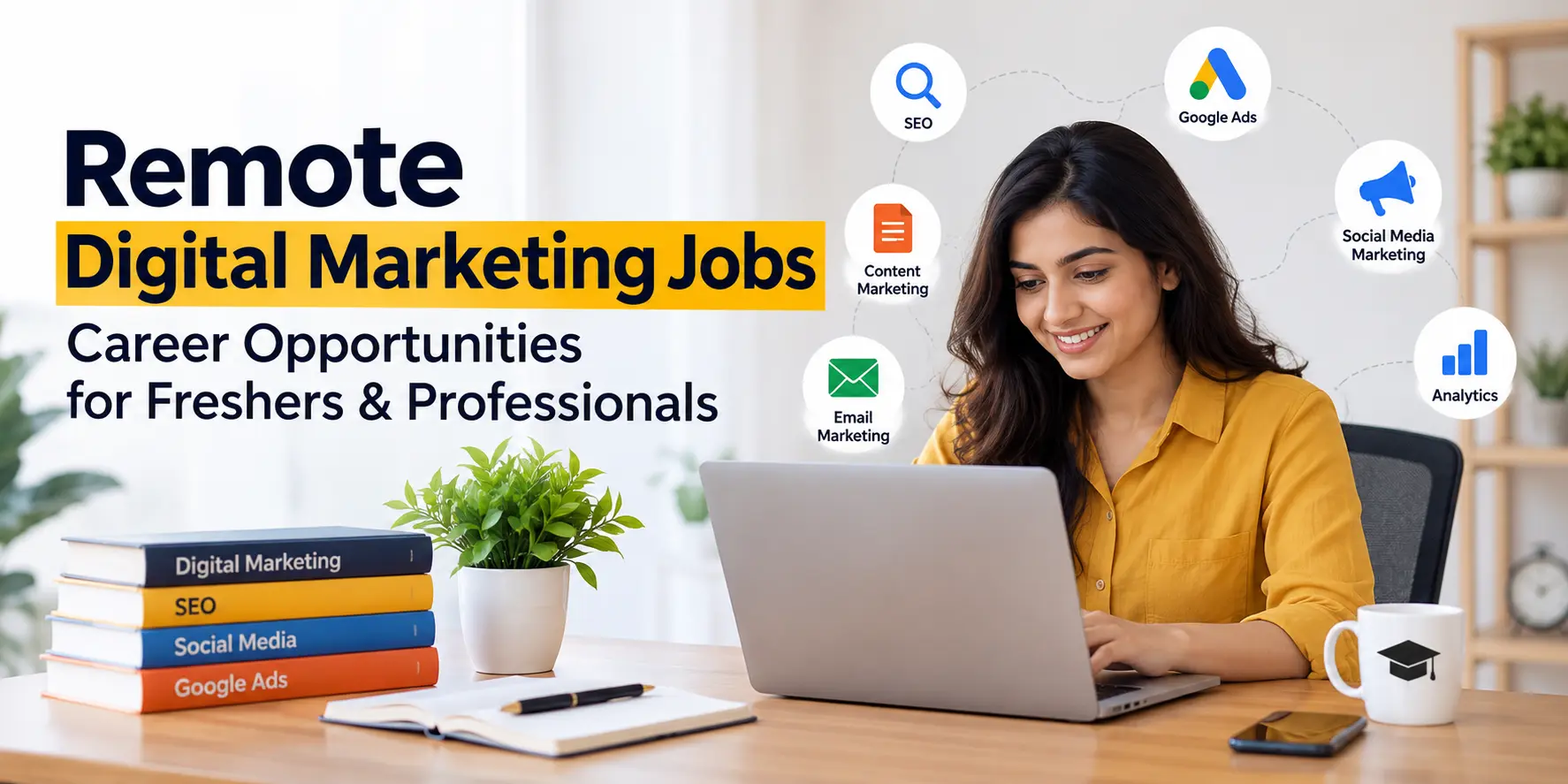
The way people work has changed significantly in recent years. Businesses that once required employees to work from a physical office are increasingly building remote and hybrid teams. Digital marketing is one of the fields that fits particularly well with remote work because most marketing activities can be planned, executed, measured, and communicated online.
This has created growing interest in remote digital marketing jobs among students, freshers, working professionals, freelancers, and people looking for flexible career opportunities.
From SEO and Google Ads to social media, content marketing, email marketing, analytics, and AI-powered marketing, there are now many digital marketing roles that can be performed remotely.
But getting a remote job is not simply about having a laptop and knowing how to use social media. Employers want professionals who can understand marketing objectives, use relevant tools, communicate effectively, analyze performance, and deliver measurable results.
In this guide, we'll explore the different remote digital marketing jobs, career opportunities for freshers and experienced professionals, required skills, salary factors, portfolio requirements, and practical steps to start a remote digital marketing career.
What Are Remote Digital Marketing Jobs?
Remote digital marketing jobs are marketing positions that allow professionals to perform their responsibilities from a location outside the company's traditional office.
Depending on the employer, remote work may be:
Fully remote
Partially remote
Work from home
Remote with occasional meetings
Freelance or contract-based
A remote digital marketer may communicate with clients and team members through video meetings, email, project-management platforms, and messaging applications.
Most daily tasks can be completed using digital tools, making digital marketing particularly suitable for remote employment.
For example, an SEO professional can research keywords, optimize webpages, monitor rankings, analyze Search Console data, and prepare reports without being physically present in an office.
Similarly, a social media manager can create content calendars, schedule posts, manage campaigns, and analyze engagement remotely.
Why Are Remote Digital Marketing Jobs Growing?
Several factors are contributing to the growth of remote marketing opportunities.
Digital Businesses Need Digital Marketers
Companies increasingly depend on online channels to attract customers. Whether it is a local business, startup, e-commerce company, educational institute, or technology company, digital visibility has become important.
Businesses therefore need professionals who can manage:
Search engine optimization
Paid advertising
Social media
Content
Email marketing
Analytics
Online reputation
Marketing automation
Because these activities are digitally managed, they can often be performed from almost anywhere.
Companies Can Hire Talent Beyond Their Local Area
Remote hiring allows companies to find professionals based on skills rather than geographical location alone.
This creates opportunities for marketers to work with businesses located in different cities, states, or countries.
Digital Marketing Tools Support Remote Collaboration
Modern tools allow marketing teams to work together without sharing the same physical office.
Teams can collaborate using:
Google Workspace
Slack
Microsoft Teams
Zoom
Project management platforms
Analytics platforms
Advertising dashboards
SEO tools
Content management systems
This makes digital marketing one of the more flexible career fields for remote work.
Types of Remote Digital Marketing Jobs
One of the biggest advantages of digital marketing is the variety of career paths available.
You don't necessarily need to become an expert in every area. You can develop a specialization based on your interests and career goals.
1. Remote SEO Jobs
Search Engine Optimization is one of the most popular areas for remote digital marketing work.
An SEO professional may be responsible for:
Keyword research
Competitor analysis
Content optimization
Internal linking
Local SEO
Search Console analysis
SEO reporting
Website audits
SEO professionals can work remotely for agencies, startups, e-commerce companies, SaaS businesses, publishers, and other organizations.
2. Remote Google Ads and PPC Jobs
Paid advertising is another area with strong remote potential.
A PPC or Google Ads specialist may manage:
Search campaigns
Display campaigns
Remarketing
Shopping campaigns
Keyword research
Ad copy
Audience targeting
Conversion tracking
Budget optimization
Performance reports
Because advertising platforms are online, campaigns can generally be managed remotely.
Professionals who understand both campaign setup and performance analysis can build strong careers in this field.
3. Remote Social Media Marketing Jobs
Social media marketing is naturally suited to remote work.
A social media professional may handle:
Content calendars
Captions
Creative briefs
Social media scheduling
Community management
Influencer coordination
Paid social campaigns
Audience engagement
Social media analytics
However, successful social media marketing requires more than posting regularly.
Professionals need to understand the brand, target audience, content strategy, trends, and business objectives.
4. Remote Content Marketing Jobs
Content marketing professionals create useful content designed to attract, educate, engage, or convert an audience.
Remote content roles may involve creating:
Blog posts
Website content
Landing pages
Case studies
Email content
Video scripts
Strong writing, research, SEO knowledge, and audience understanding can help professionals succeed in remote content marketing roles.
5. Remote Email Marketing Jobs
Email marketing is another area where professionals can work remotely.
Responsibilities may include:
Creating newsletters
Developing email campaigns
Segmenting audiences
Writing subject lines
Building automated workflows
Monitoring open and click rates
Testing campaigns
Improving conversions
Knowledge of email automation platforms and customer journeys can be particularly useful for this career path.
6. Remote Performance Marketing Jobs
Performance marketing focuses on measurable business outcomes such as leads, sales, conversions, and revenue.
A performance marketer may work with:
Google Ads
Meta Ads
Landing pages
Conversion tracking
Analytics
Remarketing
Campaign optimization
This role requires strong analytical thinking because marketers need to understand what is driving results and where advertising budgets should be adjusted.
7. Remote Digital Marketing Executive Jobs
Digital Marketing Executive is often one of the entry-level roles available to freshers.
Depending on the organization, an executive may work on several areas, including:
SEO
Social media
Content
Email marketing
Website updates
Analytics
Campaign support
This can be a useful starting point for beginners who want to gain exposure to different digital marketing channels before specializing.
Can Freshers Get Remote Digital Marketing Jobs?
Yes, freshers can find remote digital marketing opportunities, but competition can be higher than for traditional office-based entry-level roles.
The biggest challenge for freshers is often a lack of practical experience.
Employers may ask:
"What have you actually worked on?"
A certificate can demonstrate that you completed a course, but a portfolio can demonstrate what you can do.
Freshers can improve their chances by creating practical projects such as:
SEO audits
Keyword research reports
Sample Google Ads campaigns
Social media calendars
Blog writing samples
Website optimization projects
Analytics reports
Content strategies
You can even create a practice project around a hypothetical business and document your complete marketing strategy.
Skills Required for Remote Digital Marketing Jobs
Working remotely requires both technical marketing skills and professional communication skills.
Technical Skills
Depending on your specialization, useful skills include:
SEO
Google Ads
Meta Ads
Social media marketing
Content marketing
Email marketing
Google Analytics 4
Google Tag Manager
WordPress
Keyword research
Conversion optimization
Marketing automation
AI-powered marketing tools
You don't need to master everything at once.
Start with the fundamentals and gradually build specialization.
Soft Skills Are Equally Important
Remote employees need to communicate clearly because colleagues and clients may not be sitting next to them.
Important soft skills include:
Communication
You should be able to explain your ideas, campaign results, and problems clearly.
Time Management
Remote work provides flexibility, but you still need to complete tasks on time.
Self-Motivation
Without constant supervision, professionals must manage their own productivity.
Problem Solving
Digital campaigns don't always perform as expected. Marketers need to identify problems and develop solutions.
Adaptability
Digital marketing changes quickly. Search engines, advertising platforms, social networks, and AI tools continue to evolve.
AI and the Future of Remote Digital Marketing Jobs
Artificial Intelligence is changing digital marketing, but it doesn't necessarily mean fewer opportunities.
AI can help marketers with:
Content ideation
Keyword research
Data analysis
Campaign insights
Ad copy variations
Customer segmentation
Marketing automation
Reporting
Personalization
However, human marketers still need to provide:
Strategy
Creativity
Brand understanding
Customer insight
Critical thinking
Decision-making
This means future professionals should learn how to work with AI rather than compete against it.
A digital marketer who understands marketing fundamentals and knows how to use AI effectively can potentially become more productive and valuable.
What Tools Should You Learn?
If you want to prepare for remote digital marketing jobs, become comfortable with the tools commonly used in marketing workflows.
SEO & Analytics
Google Search Console
Google Analytics 4
Google Tag Manager
SEO research and auditing tools
Advertising
Google Ads
Meta Ads Manager
LinkedIn advertising tools
Website & Content
WordPress
Content management systems
Canva
AI productivity tools
Communication
Google Meet
Zoom
Slack
Microsoft Teams
Email
You don't have to master every tool before applying for your first job. Focus on the tools relevant to the role you want.
How Much Can You Earn in Remote Digital Marketing?
Remote digital marketing salaries vary considerably based on:
Experience
Skill specialization
Company
Location
Industry
Job responsibilities
Technical expertise
Performance
Client portfolio
A fresher may begin with an entry-level digital marketing role, while experienced professionals can move into specialist, strategist, manager, consultant, or leadership positions.
Freelancers may charge per project, per hour, or through monthly retainers.
Rather than focusing only on a specific salary figure, beginners should concentrate on building skills that increase their market value.
For example, a professional who understands SEO + analytics + AI + content strategy may have a broader skill set than someone who only knows how to publish social media posts.
Remote Job vs Freelancing: What's the Difference?
Remote employment and freelancing are often confused, but they are different career models.
Remote Job | Freelancing |
|---|---|
Usually works for one employer | Can work with multiple clients |
Regular salary | Project or retainer-based income |
Defined responsibilities | Responsibilities vary by client |
Employer-managed workflow | Freelancer manages workflow |
Greater income predictability | Income can fluctuate |
May include employee benefits | Usually self-managed |
Both options can be excellent.
A fresher may prefer a remote job to gain structured experience, while an experienced professional may choose freelancing for greater flexibility.
Some professionals eventually combine both by working remotely while taking selected freelance projects.
How to Build a Portfolio for Remote Digital Marketing Jobs
A strong portfolio can make a significant difference when applying for remote positions.
Your portfolio should demonstrate what you can actually do.
Include examples such as:
SEO
Keyword research
SEO audit
On-page optimization
Content strategy
Paid Advertising
Sample campaign structure
Keyword planning
Ad copy
Landing page recommendations
Social Media
Content calendar
Sample posts
Campaign strategy
Performance analysis
Content
Blog samples
Website copy
Landing page content
SEO content
Analytics
Sample reports
KPI dashboards
Conversion analysis
Don't simply list skills.
Show the work.
How to Find Legitimate Remote Digital Marketing Jobs
When searching for remote opportunities, use established professional job platforms, company career pages, and professional networking channels.
Search using terms such as:
Remote Digital Marketing Executive
Remote SEO Executive
Remote SEO Specialist
Remote PPC Specialist
Remote Social Media Manager
Remote Content Writer
Remote Performance Marketing Executive
Remote Digital Marketing Manager
Always research the company before accepting an offer.
Be cautious if a recruiter:
Requests money to provide a job
Asks for unnecessary financial information
Promises unusually high earnings with no experience
Refuses to provide company information
Uses suspicious email addresses
Pressures you to make immediate payments
A legitimate employer should provide clear information about the position, responsibilities, hiring process, and compensation.
How to Get Remote Digital Marketing Jobs as a Fresher
If you're starting from zero, follow a structured approach.
Step 1: Learn Digital Marketing Fundamentals
Understand SEO, paid advertising, social media, content marketing, analytics, and conversion funnels.
Step 2: Choose a Specialization
After learning the basics, identify the area you enjoy most.
For example:
SEO + Content
or
Google Ads + Performance Marketing
or
Social Media + Content Creation
Step 3: Practice
Work on websites, sample campaigns, content calendars, and analytics exercises.
Step 4: Build Your Portfolio
Document your projects and explain the strategy and results.
Step 5: Optimize Your Resume
Highlight practical skills instead of only listing course certificates.
Step 6: Build Your LinkedIn Profile
Showcase your projects, certifications, skills, and professional interests.
Step 7: Apply Consistently
Don't expect your first application to result in a job.
Apply strategically and improve your resume and portfolio based on feedback.
Why Practical Training Matters
Digital marketing is easier to understand when you actually implement it.
For example, reading about SEO can teach you what keyword research means. Performing keyword research for a real website teaches you how to evaluate search intent, relevance, competition, and business value.
The same principle applies to Google Ads, social media marketing, analytics, and content creation.
A career-focused digital marketing program should ideally provide exposure to:
Live projects
SEO implementation
Google Ads
Meta Ads
Social media
WordPress
Google Analytics
Google Tag Manager
AI tools
Content marketing
Portfolio development
Interview preparation
At LearnToDigital, practical learning can help students move beyond theory and develop skills relevant to real digital marketing workflows.
Is Remote Digital Marketing a Good Career for the Future?
For people who enjoy technology, creativity, communication, and continuous learning, digital marketing can offer a flexible career path.
The future is likely to bring further changes through:
Artificial Intelligence
Automation
Data-driven marketing
AI-powered search
Personalization
Marketing analytics
Video content
E-commerce growth
As these technologies develop, marketers will need to continuously update their skills.
The professionals who adapt to new tools while maintaining strong marketing fundamentals can position themselves for long-term opportunities.
Final Thoughts
Remote digital marketing jobs offer exciting opportunities for both freshers and experienced professionals.
Whether you want to work as an SEO specialist, PPC professional, social media manager, content marketer, performance marketer, or digital marketing executive, there are multiple career paths to explore.
However, getting a remote job requires more than simply completing a digital marketing course.
You need a combination of:
Practical Skills + Portfolio + Communication + Industry Knowledge + Adaptability
For freshers, the best starting point is to learn the fundamentals, work on practical projects, build a portfolio, and gradually specialize.
For experienced professionals, developing advanced skills in analytics, performance marketing, AI, automation, and strategy can create new opportunities.
Remote work provides flexibility, but professional growth still depends on the value you bring to an organization.
Learn the skills. Build the portfolio. Stay updated. Then take your digital marketing career wherever you want to go.