
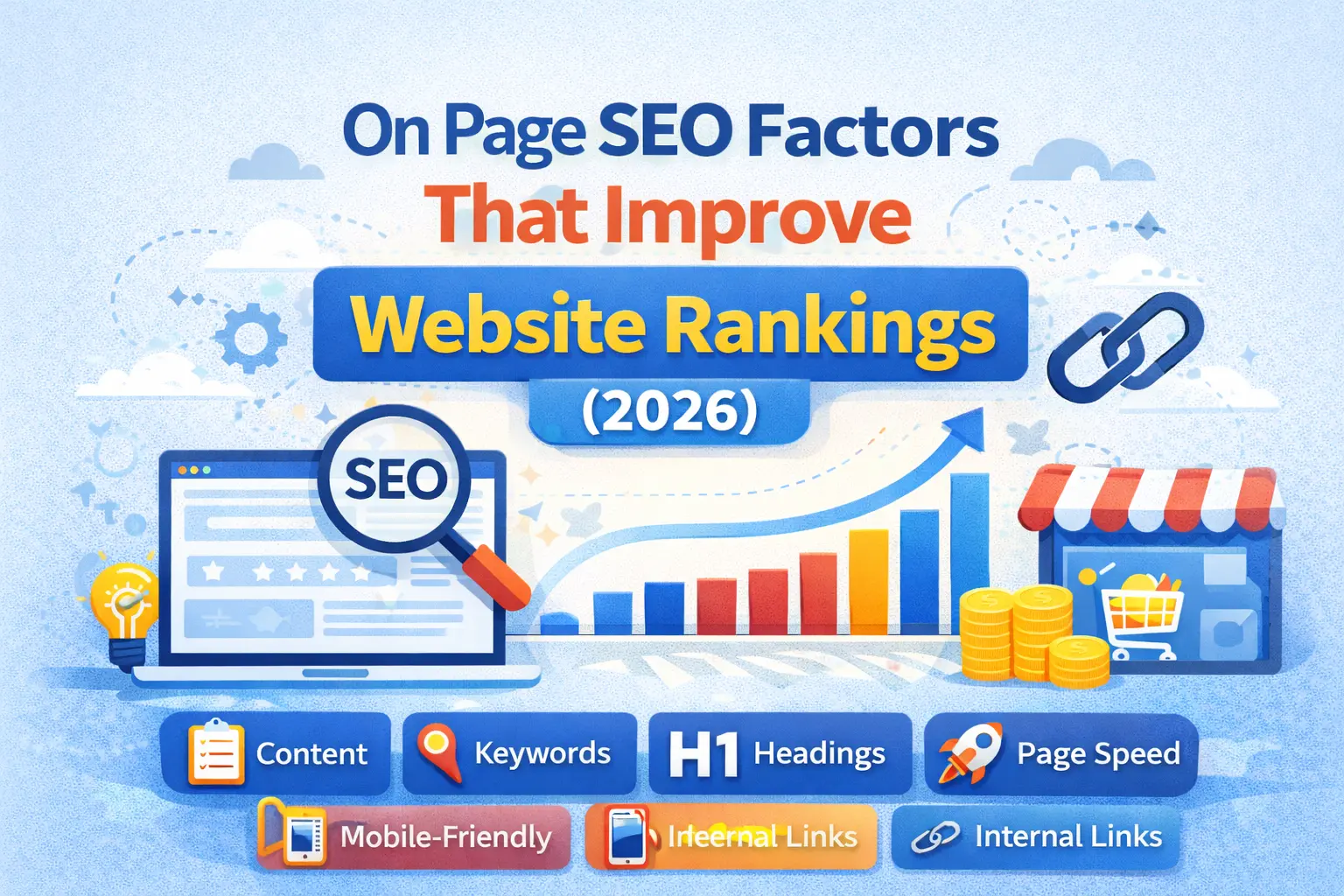
If you want to rank higher on Google, on page SEO factors are the first thing you must master.
Many websites fail to rank not because of lack of backlinks but because their on page SEO foundation is weak. Google can only rank content it clearly understands, and that understanding comes from on page SEO.
In this detailed guide, you’ll learn:
What on page SEO factors are
Why they are critical for rankings
The most important on page SEO factors
How to optimize them with real examples
How beginners can implement them practically
What Are On Page SEO Factors?
On page SEO factors are all the elements you optimize within your website pages to improve search engine rankings and user experience.
These factors help Google:
Understand what your page is about
Measure content quality
Evaluate user satisfaction
Decide ranking positions
In Simple Words:
On page SEO factors = What Google sees on your page
Why On Page SEO Factors Are Important for Rankings
Google’s main goal is to show the best possible result to users.
On page SEO factors help Google answer:
Is this content relevant?
Is it helpful?
Is it well-structured?
Does it satisfy user intent?
Without strong on page SEO:
Pages won’t rank consistently
Traffic won’t convert
Off page SEO becomes less effective
Top On Page SEO Factors That Matter the Most
Below are the most important on page SEO factors, explained step by step.
1. High-Quality, Intent-Focused Content
Content is the #1 on page SEO factor.
Google ranks pages that:
Match search intent
Solve user problems
Provide complete answers
Types of Search Intent:
Informational (learn)
Commercial (compare)
Transactional (buy)
Example:
Keyword: on page seo factors
Intent: Informational + learning
So the content should:
✔ Explain clearly
✔ Use examples
✔ Avoid sales-heavy language
2. Keyword Optimization (Without Stuffing)
Keyword optimization tells Google what your page is about.
Correct Keyword Placement:
Title tag
URL
H1 heading
First 100 words
H2/H3 headings
Image alt text
Conclusion
❌ Keyword stuffing hurts rankings
✅ Natural usage improves relevance
Example:
Instead of repeating “on page seo factors” unnaturally, use related terms like:
On page SEO elements
On site SEO factors
Website optimization factors
3. SEO-Friendly Title Tag
The title tag is:
A ranking factor
A click-through factor
Best Practices:
Keep under 60 characters
Include primary keyword
Add benefit or year
Example:
On Page SEO Factors That Improve Website Rankings (2026)
A strong title = better CTR = better rankings.
4. Optimized Meta Description
Meta descriptions don’t directly affect rankings, but they:
Improve CTR
Attract qualified traffic
Best Practices:
150–160 characters
Include keyword naturally
Highlight benefit
Example:
“Learn the most important on page SEO factors that improve website rankings. Beginner-friendly guide with examples and best practices.”
5. Proper Heading Structure (H1–H6)
Headings help:
Search engines understand structure
Users scan content easily
Ideal Structure:
H1 – Main topic
H2 – Main sections
H3 – Sub-points
SEO Benefit:
Better crawlability
Featured snippet eligibility
Improved readability
6. URL Optimization
Clean URLs are an underrated on page SEO factor.
SEO-Friendly URL:
Short
Descriptive
Keyword included
No special characters
❌ example.com/p=123
✅ example.com/on-page-seo-factors
7. Internal Linking Strategy
Internal links connect pages within your website.
Why Internal Linking Matters:
Distributes page authority
Improves crawl depth
Guides users
Example:
Blog → SEO course page
Blog → related SEO articles
This strengthens topical authority.
8. Image Optimization (ALT Text & Size)
Images help UX but must be optimized.
On Page SEO Image Factors:
Descriptive file names
ALT text with keywords
Compressed file size
Proper dimensions
Example ALT Text:
“on page seo factors checklist”
9. Page Speed & Core Web Vitals
Google prioritizes fast-loading pages.
Key Metrics:
Largest Contentful Paint (LCP)
Interaction to Next Paint (INP)
Cumulative Layout Shift (CLS)
Optimisation Tips:
Compress images
Reduce scripts
Use caching
Mobile-first design
Slow pages = ranking loss.
10. Mobile-Friendliness
Google uses mobile-first indexing.
Your website must:
Be responsive
Load fast on mobile
Have readable fonts
Easy navigation
Mobile UX is a direct on page SEO factor.
11. Content Readability & UX
If users don’t read, Google notices.
Improve Readability:
Short paragraphs
Bullet points
Simple language
White space
Result:
Lower bounce rate
Higher dwell time
Better rankings
12. Schema Markup (Structured Data)
Schema helps Google understand content context.
Examples:
FAQ schema
Article schema
Breadcrumb schema
Schema improves:
Rich results
CTR
SERP visibility
On Page SEO Factors Checklist (Quick Table)
Factor | Importance |
|---|---|
Content quality | ⭐⭐⭐⭐⭐ |
Keyword optimization | ⭐⭐⭐⭐⭐ |
Title tag | ⭐⭐⭐⭐ |
Meta description | ⭐⭐⭐ |
Headings | ⭐⭐⭐⭐ |
Internal links | ⭐⭐⭐⭐ |
Page speed | ⭐⭐⭐⭐⭐ |
Mobile friendliness | ⭐⭐⭐⭐⭐ |
Image optimization | ⭐⭐⭐ |
UX & readability | ⭐⭐⭐⭐ |
Common On Page SEO Mistakes to Avoid
❌ Keyword stuffing
❌ Thin content
❌ Duplicate content
❌ Missing internal links
❌ Slow website
❌ Ignoring mobile users
Avoiding these mistakes alone can improve rankings significantly.
External SEO Resources
For deeper understanding, you can refer to:
Google Search Central – On Page SEO Guidelines
Moz On Page SEO Guide
Ahrefs SEO Learning Hub
These are globally trusted SEO sources.
How to Learn On Page SEO Factors Practically
Reading blogs builds knowledge.
Practicing SEO builds expertise.
This is where structured learning helps.
Learn On Page SEO Practically with LearnToDigital
At LearnToDigital, students don’t just learn theory they implement on page SEO factors on real websites.
What You’ll Learn:
Keyword research & intent mapping
Content optimization
Internal linking strategies
Technical on page SEO
Live projects & tools
SEO audits
Why LearnToDigital?
Beginner-friendly teaching
Industry-oriented curriculum
Live practical sessions
Career & freelance guidance
Learn SEO the way Google expects it to be done.
Final Thoughts
On page SEO factors are the foundation of every successful SEO strategy.
Without strong on page SEO:
Rankings fail
Traffic doesn’t convert
Growth becomes unstable
Master these factors once and they’ll benefit every page you create.
SEO is not about tricks.
It’s about doing the basics better than everyone else.
References:
Google Search Central – SEO Starter Guide
https://developers.google.com/search/docs/fundamentals/seo-starter-guideGoogle Search Central – Title Links & Snippets
https://developers.google.com/search/docs/appearance/title-linkGoogle Search Central – URL Structure Best Practices
https://developers.google.com/search/docs/crawling-indexing/url-structureGoogle Search Central – Image SEO Best Practices
https://developers.google.com/search/docs/appearance/google-imagesGoogle Search Central – Core Web Vitals
https://developers.google.com/search/docs/appearance/core-web-vitals