
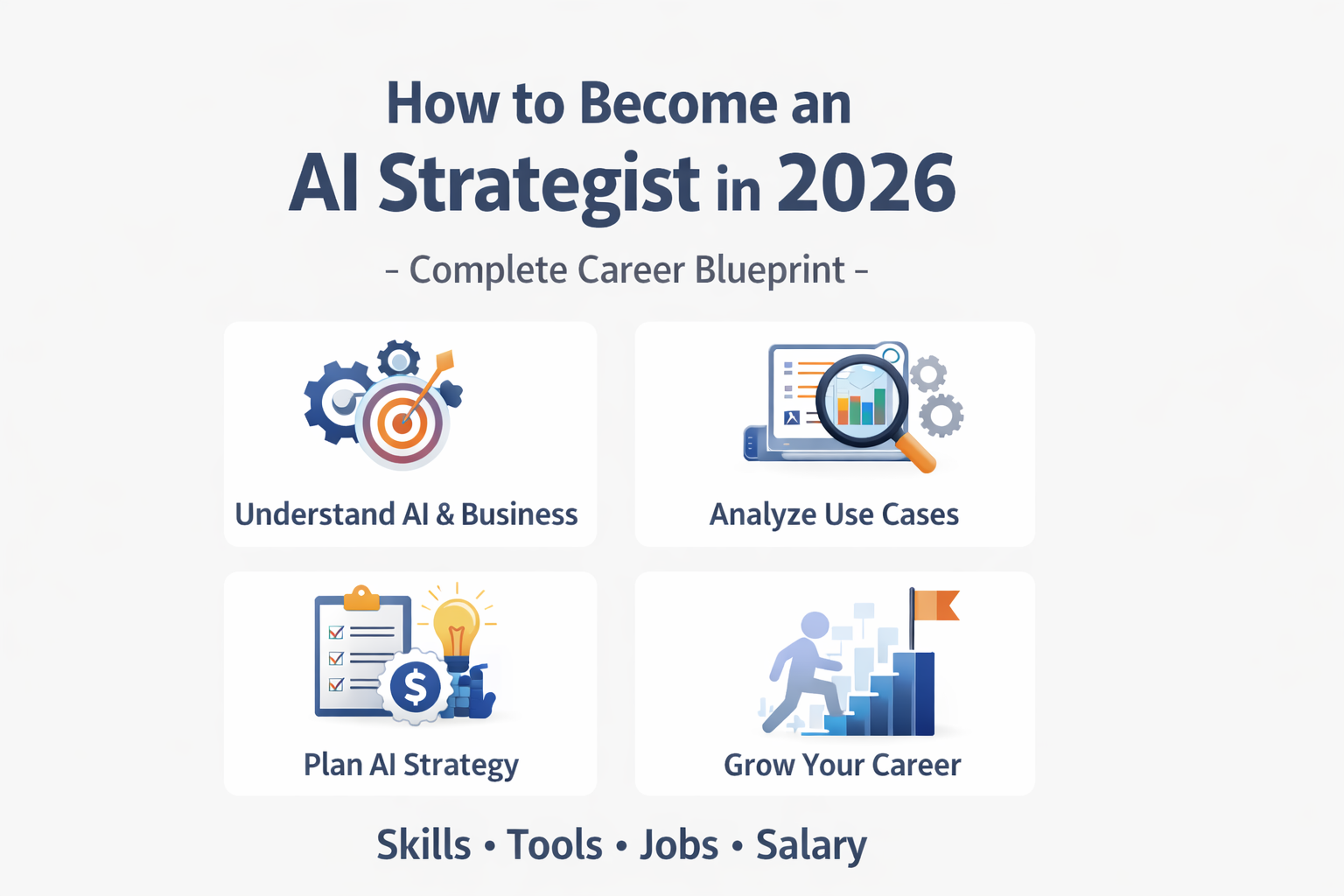
Artificial Intelligence is no longer limited to engineers and data scientists. In 2026, companies are looking for professionals who can connect AI capabilities with real business goals. This is where the role of an AI Strategist comes in.
If you’re wondering how to enter this high-impact, future-ready career, this guide will walk you through what an AI strategist does, the skills you need, learning paths, tools, job roles, and a clear step-by-step roadmap to get started.
What Is an AI Strategist?
An AI Strategist is a professional who helps businesses plan, adopt, and scale AI solutions in a practical, ethical, and profitable way. Instead of building models from scratch, AI strategists focus on decision-making, use-case identification, and implementation strategy.
In simple terms:
Data scientists build AI
Engineers deploy AI
AI strategists decide where, why, and how AI should be used
This role sits at the intersection of technology, business strategy, and innovation.
Why AI Strategists Are in High Demand in 2026
AI adoption has accelerated across industries like marketing, healthcare, finance, education, e-commerce, and SaaS. However, many organizations struggle with:
Choosing the right AI tools
Aligning AI with business objectives
Managing costs, risks, and ethics
That gap has created strong demand for AI strategists who can translate AI potential into real outcomes.
Key reasons this career is booming:
Businesses want ROI from AI, not experiments
AI tools are becoming accessible to non-coders
Leadership teams need AI-literate decision makers
Regulations and ethics require strategic oversight
What Does an AI Strategist Do?
An AI strategist’s responsibilities vary by organization, but typically include:
Identifying business problems that AI can solve
Evaluating AI tools, platforms, and vendors
Designing AI adoption roadmaps
Collaborating with technical and non-technical teams
Ensuring ethical and responsible AI use
Measuring performance and ROI of AI initiatives
They act as bridge builders between leadership, product teams, marketers, analysts, and engineers.
Skills You Need to Become an AI Strategist
You don’t need to be a hardcore programmer, but you do need a balanced skill set.
1. Business & Strategic Thinking
Understanding business models and workflows
Problem-solving and decision-making
Cost-benefit and ROI analysis
2. AI & Data Literacy
How AI, machine learning, and generative AI work (conceptually)
Understanding data types, models, and limitations
Knowing what AI can and cannot do
3. Domain Knowledge
AI strategists are more valuable when they understand a specific domain such as:
Marketing & growth
Finance & risk
HR & talent
Healthcare
E-commerce
4. Communication & Leadership
Explaining AI concepts in simple language
Presenting strategies to stakeholders
Managing cross-functional teams
5. Ethics & Governance Awareness
Bias, data privacy, and compliance
Responsible AI practices
Risk management
Educational Background: What Should You Study?
There is no single “AI Strategist degree,” but successful professionals usually come from backgrounds like:
Business & management
Marketing or analytics
Engineering or IT
Economics or statistics
In 2026, certifications and applied learning matter more than formal degrees.
Recommended learning areas:
AI fundamentals & generative AI
Data analytics basics
Product management or digital strategy
Industry-specific AI use cases
Tools Every AI Strategist Should Know
You don’t need to master all tools, but you should understand how they are used strategically.
Common categories:
AI platforms: Chatbots, automation tools, predictive analytics
Data tools: Dashboards, reporting, visualization
No-code / low-code AI tools: For rapid implementation
Project & strategy tools: Roadmaps, workflows, documentation
The goal is not tool dependency, but tool evaluation and selection.
Step-by-Step Career Roadmap (2026)
Step 1: Build AI Awareness
Start by understanding how AI works at a high level. Focus on:
Generative AI concepts
Real-world AI applications
Case studies across industries
Step 2: Learn Business-Driven AI Use Cases
Shift from “what AI can do” to “what AI should do”.
Customer experience automation
Marketing personalization
Process optimization
Decision support systems
Step 3: Develop a Specialization
Choose one domain (marketing, operations, finance, HR, etc.) and learn how AI is applied there. Specialists get hired faster than generalists.
Step 4: Gain Hands-On Experience
You can:
Work on internal AI projects
Build mock strategies and case studies
Freelance or consult for small businesses
Collaborate with startups
Step 5: Build a Portfolio
Show your thinking, not just tools:
AI strategy frameworks
Before-and-after business impact
Use-case proposals
ROI models
Step 6: Apply for Roles or Consulting Opportunities
Look for titles such as:
AI Strategist
AI Product Strategist
Digital Transformation Consultant
AI Solutions Consultant
Innovation Manager
AI Digital Marketing Analyst
Salary & Career Growth Outlook
AI strategists are among the fastest-growing strategy roles globally. Salaries depend on experience, domain expertise, and region, but the growth curve is strong because:
AI strategy roles scale with business impact
Professionals often move into leadership roles
Consulting and freelancing opportunities are expanding
With experience, AI strategists can progress into:
Head of AI Strategy
Chief AI Officer (CAIO)
Digital Transformation Leader
Is AI Strategist the Right Career for You?
This role is ideal if you:
Enjoy problem-solving and big-picture thinking
Like working between technology and business
Want a future-proof, non-routine career
Prefer strategy over pure coding
If you’re curious about AI but don’t want to be limited to technical roles, AI strategy is one of the smartest career choices in 2026.
Conclusion
Becoming an AI Digital strategist is not about chasing trends - it’s about learning how to think strategically in an AI-driven world. The professionals who succeed in this role are those who combine curiosity, business sense, ethical awareness, and continuous learning.
Start small, build practical understanding, focus on impact, and evolve with technology. In 2026 and beyond, AI strategists will be the decision-makers shaping how AI truly transforms businesses.