
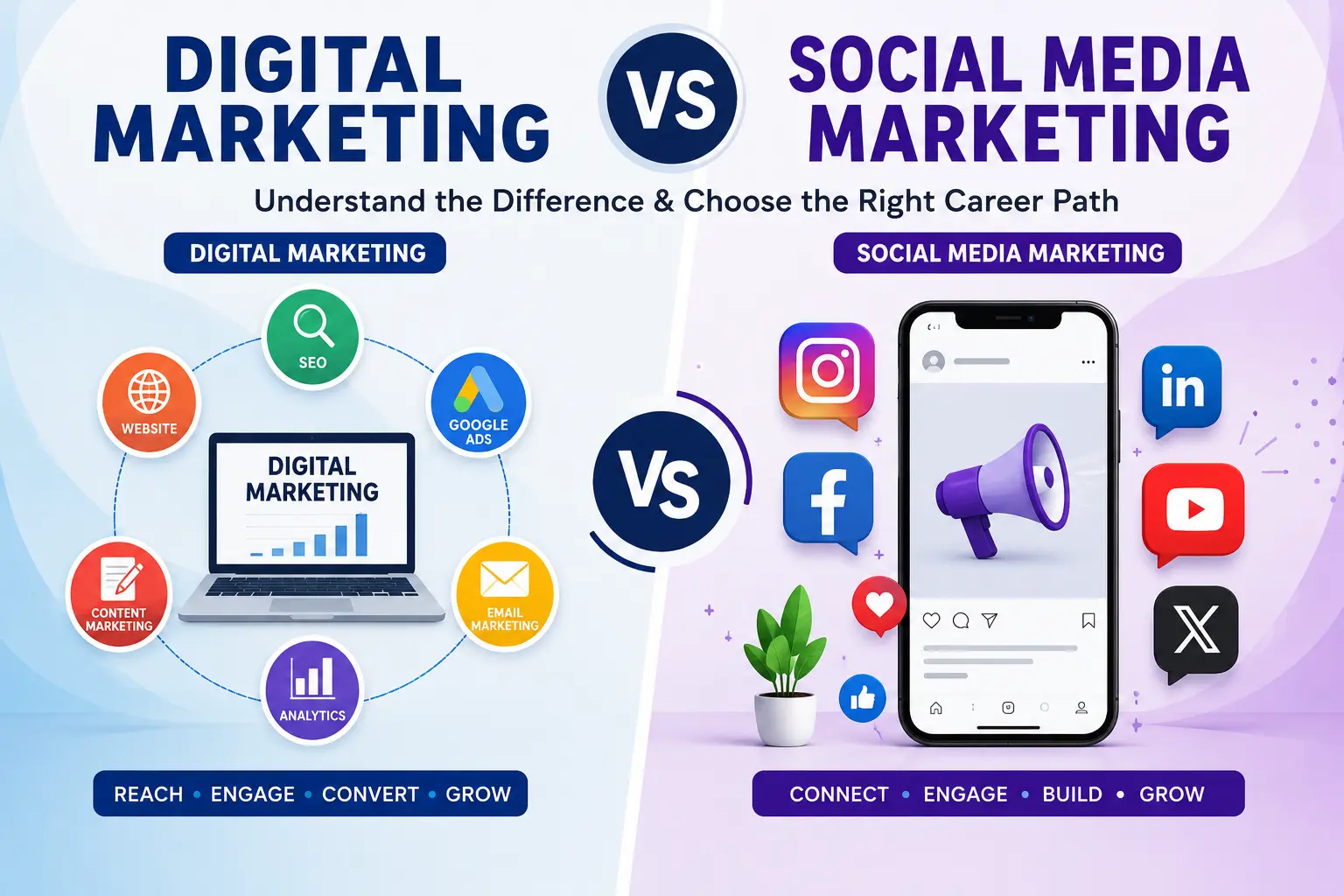
In today's digital-first world, businesses rely heavily on online platforms to reach their customers. As a result, careers in digital marketing have become more popular than ever. However, one question that many students, job seekers, and business owners often ask is: "What is the difference between Digital Marketing and Social Media Marketing?"
Although these terms are frequently used interchangeably, they are not the same. Social Media Marketing is just one component of Digital Marketing. While digital marketing covers every online channel used to promote a business, social media marketing focuses specifically on building brand awareness and engaging audiences through platforms like Instagram, Facebook, LinkedIn, X (formerly Twitter), and YouTube.
Understanding this difference is important whether you're planning to build a career, grow your business, or enroll in a professional training program.
In this comprehensive guide, we'll explain the differences between digital marketing and social media marketing, explore career opportunities, compare required skills, discuss salaries, and help you decide which path is right for you.
What is Digital Marketing?
Digital Marketing refers to the promotion of products, services, or brands using digital channels and internet-based technologies. It involves multiple strategies designed to attract potential customers, generate leads, increase website traffic, and improve online sales.
Unlike traditional marketing, digital marketing allows businesses to measure campaign performance in real time, making it easier to optimize strategies and improve results.
A complete digital marketing strategy usually includes several specialized areas.
Major Components of Digital Marketing
Search Engine Optimization (SEO)
SEO helps websites rank higher on search engines like Google by optimizing content, improving website structure, and enhancing user experience.
Search Engine Marketing (SEM)
SEM focuses on paid advertising through platforms like Google Ads to generate immediate visibility and qualified traffic.
Social Media Marketing (SMM)
This involves promoting businesses on social platforms through organic content, paid advertising, influencer collaborations, and community engagement.
Content Marketing
Creating valuable blogs, videos, infographics, podcasts, and downloadable resources helps businesses attract and educate their target audience.
Email Marketing
Businesses use email campaigns to nurture leads, promote offers, and maintain long-term customer relationships.
Affiliate Marketing
Brands collaborate with affiliates who promote products and earn commissions on successful sales.
Influencer Marketing
Businesses partner with creators and influencers to reach highly engaged audiences.
Analytics & Performance Tracking
Tools like Google Analytics and Google Tag Manager help marketers measure website traffic, conversions, and campaign effectiveness.
AI-Powered Marketing
Modern digital marketing increasingly incorporates Artificial Intelligence for:
Content creation
SEO research
Customer support
Marketing automation
Data analysis
Personalization
AI has become an essential skill for today's digital marketers.
What is Social Media Marketing?
Social Media Marketing (SMM) is a specialized branch of digital marketing that focuses exclusively on promoting businesses through social media platforms.
Its primary goal is to build brand awareness, engage audiences, generate leads, and increase customer loyalty.
Instead of targeting search engines, social media marketers focus on creating content that resonates with users on platforms where they spend their time.
Popular social media platforms include:
Facebook
Instagram
LinkedIn
YouTube
X (formerly Twitter)
Pinterest
Snapchat
Threads
Each platform requires a different content strategy, audience approach, and advertising method.
What Does a Social Media Marketer Do?
A social media marketer is responsible for managing a brand's online presence across social platforms.
Daily responsibilities often include:
Creating content calendars
Designing social media posts
Writing captions
Publishing content
Managing communities
Responding to comments
Running Meta Ads
Collaborating with influencers
Monitoring analytics
Tracking engagement metrics
The role requires creativity, communication skills, and an understanding of audience behavior.
Digital Marketing vs Social Media Marketing
Although both fields aim to grow businesses online, their scope and responsibilities differ significantly.
Feature | Digital Marketing | Social Media Marketing |
|---|---|---|
Scope | Broad | Specific |
Channels | Search engines, websites, email, ads, social media, content | Social media platforms only |
Main Goal | Generate traffic, leads, and sales | Build engagement and brand awareness |
SEO | ✔ Yes | ✖ No |
Google Ads | ✔ Yes | Limited |
Meta Ads | ✔ Yes | ✔ Yes |
Email Marketing | ✔ Yes | ✖ No |
Website Optimization | ✔ Yes | ✖ No |
Analytics | Extensive | Social platform analytics |
Content Strategy | Multiple channels | Social platforms only |
From this comparison, it's clear that Social Media Marketing is a subset of Digital Marketing, not a separate alternative.
Key Skills Required
Digital Marketing Skills
Professionals in digital marketing typically develop expertise in:
SEO
Google Ads
Keyword research
Analytics
Conversion optimization
Email marketing
Content strategy
Website management
AI tools
Marketing automation
Data interpretation
Because digital marketers work across multiple channels, they need a broader skill set.
Social Media Marketing Skills
Social media marketers focus on skills such as:
Content creation
Graphic design basics
Copywriting
Video marketing
Community management
Influencer collaborations
Trend analysis
Meta Ads
Audience engagement
Social media analytics
Creativity and communication play a larger role in this specialization.
Which One Has a Wider Scope?
When comparing career opportunities, Digital Marketing generally offers a broader scope because it includes multiple specializations under one umbrella.
A digital marketer can choose to specialize in:
SEO
PPC Advertising
Social Media Marketing
Email Marketing
Content Marketing
Analytics
Affiliate Marketing
Performance Marketing
Marketing Automation
AI Marketing
On the other hand, a social media marketer primarily focuses on content strategy, audience engagement, and advertising across social platforms.
This broader skill set often gives digital marketers greater flexibility to explore different career paths.
Career Opportunities: Digital Marketing vs Social Media Marketing
One of the biggest reasons students choose digital marketing as a career is the growing demand across industries. Today, almost every business from startups and local stores to multinational companies needs professionals who can build an online presence and generate leads.
While both digital marketing and social media marketing offer promising careers, the range of opportunities differs.
Career Opportunities in Digital Marketing
Since digital marketing covers multiple online marketing channels, professionals can specialize in different domains based on their interests and skills.
Popular career roles include:
Digital Marketing Executive
SEO Executive
SEO Specialist
Google Ads (PPC) Specialist
Performance Marketing Executive
Content Marketing Specialist
Email Marketing Executive
Marketing Automation Specialist
Web Analytics Executive
E-commerce Marketing Executive
Affiliate Marketing Manager
Digital Marketing Manager
Growth Marketing Specialist
AI Marketing Specialist
With experience, professionals can move into leadership positions such as:
Digital Marketing Manager
Growth Marketing Manager
Head of Marketing
Marketing Consultant
Marketing Director
Because digital marketing covers multiple skills, professionals can also switch between specializations as their careers grow.
Career Opportunities in Social Media Marketing
Social media marketing focuses on creating engaging content, managing communities, and building brand awareness across social platforms.
Common job roles include:
Social Media Executive
Social Media Manager
Instagram Marketing Specialist
Facebook Ads Specialist
LinkedIn Marketing Executive
Content Creator
Community Manager
Influencer Marketing Executive
Brand Communication Executive
Social Media Strategist
This career path is ideal for individuals who enjoy creativity, storytelling, branding, and audience engagement.
Salary Comparison
Salary depends on several factors, including skills, experience, certifications, location, and company size. While exact figures vary, professionals with broader digital marketing expertise often have access to a wider range of roles and salary growth opportunities.
Digital Marketing Salary
Typical entry-level positions include:
Digital Marketing Executive
SEO Executive
PPC Executive
As professionals gain experience, they can progress to roles such as:
Performance Marketing Manager
Digital Marketing Manager
Growth Marketing Manager
Having expertise in multiple areas such as SEO, Google Ads, Analytics, AI tools, and marketing automation—can improve long-term career prospects.
Social Media Marketing Salary
Entry-level opportunities include:
Social Media Executive
Content Creator
Community Manager
With experience, professionals can advance to:
Social Media Manager
Brand Manager
Influencer Marketing Manager
Social media specialists with strong portfolios, creative skills, and paid advertising experience are often in high demand, especially in agencies, startups, and e-commerce businesses.
Which Career Offers Better Growth?
Both careers have excellent potential, but their growth paths are different.
Choose Digital Marketing if you want to:
Work across multiple marketing channels.
Learn SEO, Google Ads, Analytics, Email Marketing, and AI tools.
Build a versatile career.
Work in agencies, startups, or large organizations.
Explore freelancing or consulting.
Start your own digital marketing agency.
Because digital marketing covers several disciplines, professionals have greater flexibility to expand their careers.
Choose Social Media Marketing if you enjoy:
Content creation
Instagram and Facebook marketing
Video marketing
Branding
Creative storytelling
Influencer collaborations
Building online communities
If your passion lies in creating engaging content and connecting with audiences, social media marketing can be a rewarding specialization.
Can You Learn Both?
Absolutely.
In fact, this is the approach most employers prefer today.
A digital marketer who understands social media marketing has a significant advantage because they can:
Plan integrated marketing campaigns.
Drive traffic through multiple channels.
Improve brand visibility.
Generate leads through both organic and paid strategies.
Analyze campaign performance across platforms.
Rather than choosing one over the other, many professionals begin with digital marketing and later specialize in social media, SEO, paid advertising, or analytics based on their interests.
How AI is Transforming Both Careers
Artificial Intelligence is changing the way marketers work.
Instead of replacing marketers, AI is helping them become more productive by automating repetitive tasks and providing valuable insights.
AI in Digital Marketing
Digital marketers now use AI for:
Keyword research
Content planning
SEO optimization
Marketing automation
Customer segmentation
Campaign analysis
Email personalization
Predictive analytics
These tools help marketers make faster, data-driven decisions.
AI in Social Media Marketing
Social media professionals use AI to:
Generate content ideas
Write captions
Create images and videos
Schedule posts
Analyze audience behavior
Monitor trends
Improve advertising performance
As AI continues to evolve, professionals who know how to combine creativity with AI-powered tools will have a competitive advantage.
Which Course Should You Choose?
If you're just starting your career, enrolling in a comprehensive Digital Marketing Course is usually the better option.
Why?
Because it covers:
SEO
Google Ads
Social Media Marketing
Content Marketing
Email Marketing
Google Analytics
WordPress
AI-powered marketing tools
Lead generation
Performance marketing
Once you develop a strong foundation, you can specialize in social media marketing if that aligns with your career goals.
Learning digital marketing first provides broader knowledge and opens more career opportunities than focusing solely on social media marketing.
Learn Practical Skills, Not Just Theory
Regardless of the course you choose, practical experience is what truly prepares you for the industry.
Look for a training program that offers:
Live projects
Website optimization
Real campaign exposure
AI-powered marketing tools
Hands-on assignments
Industry mentorship
Internship opportunities
Placement assistance
Practical learning builds confidence and helps you become job-ready from day one.
Digital Marketing vs Social Media Marketing: Quick Comparison
Feature | Digital Marketing | Social Media Marketing |
|---|---|---|
Definition | Promotes businesses using all digital channels | Promotes businesses only on social media platforms |
Scope | Broad | Specialized |
SEO | ✔ Yes | ✖ No |
Google Ads | ✔ Yes | Limited |
Meta Ads | ✔ Yes | ✔ Yes |
Email Marketing | ✔ Yes | ✖ No |
Website Optimization | ✔ Yes | ✖ No |
Analytics | Google Analytics, GA4, GTM & more | Platform-specific analytics |
Content Marketing | Blogs, videos, emails, websites & social | Mainly social media content |
AI Usage | SEO, PPC, automation, analytics, content | Captions, creatives, scheduling, audience insights |
Career Opportunities | Multiple specializations | Focused on social media roles |
Learning Curve | Broader | Easier to start |
Which One Should You Choose?
The answer depends on your career goals.
Choose Digital Marketing if you:
Want a broader career with multiple opportunities.
Enjoy analyzing data and solving business problems.
Want to learn SEO, Google Ads, AI, Analytics, Email Marketing, and Content Marketing.
Plan to become a freelancer or digital marketing consultant.
Dream of starting your own agency or business.
Want long-term career flexibility.
Choose Social Media Marketing if you:
Love Instagram, Facebook, LinkedIn, or YouTube.
Enjoy creating reels, posts, and short-form content.
Have a creative mindset.
Like interacting with online communities.
Want to specialize in brand communication and content creation.
The Best Career Strategy
Instead of choosing one over the other, build a strong foundation in Digital Marketing first, then specialize in Social Media Marketing.
Why?
Because social media marketing is only one part of digital marketing.
When you understand:
SEO
Google Ads
Analytics
Websites
AI
Lead Generation
Social Media
...you become a complete digital marketer with significantly more career options.
Why LearnToDigital Recommends Learning Digital Marketing First
At LearnToDigital, students are trained to become well-rounded digital marketing professionals rather than specialists in a single platform.
The curriculum is designed to provide practical exposure through:
Live website optimization
SEO implementation
Google Ads campaign planning
Meta Ads
WordPress website development
Google Analytics (GA4)
Google Tag Manager (GTM)
AI-powered marketing tools
Real business case studies
Resume building
Mock interviews
Internship guidance
Placement assistance
Once students understand the complete digital marketing ecosystem, they can confidently specialize in areas like Social Media Marketing, SEO, Performance Marketing, or AI-driven marketing based on their interests.
Final Verdict
Digital Marketing and Social Media Marketing are closely connected, but they are not the same.
Digital Marketing is a comprehensive discipline that includes multiple channels such as SEO, Google Ads, Email Marketing, Content Marketing, Website Optimization, Analytics, and Social Media Marketing.
Social Media Marketing, on the other hand, focuses exclusively on promoting brands through social platforms, building communities, increasing engagement, and creating compelling content.
If you're planning a long-term career with diverse job opportunities and higher growth potential, learning Digital Marketing provides a stronger foundation. It equips you with versatile skills that are valuable across industries and allows you to specialize later in areas such as Social Media Marketing, SEO, or Performance Marketing.
The demand for skilled digital marketers continues to grow as businesses invest more in their online presence. While social media marketing is an essential part of every marketing strategy, it represents just one piece of the broader digital marketing landscape.
If you're beginning your journey, start with a comprehensive digital marketing course that covers SEO, Google Ads, Social Media Marketing, Analytics, AI tools, and practical live projects. A strong foundation will not only improve your employability but also give you the flexibility to pursue the specialization that best matches your interests.
Ultimately, the most successful professionals are those who combine strategic thinking, practical experience, continuous learning, and adaptability to stay ahead in an ever-evolving digital world.